Watch the complete Ray Harryhausen documentary on YouTube.
A skeleton raises its sword. A bronze giant turns its head. A creature hesitates before it attacks. Ray Harryhausen’s monsters endure because their movements make them seem capable of thought. Our new, 11-minute, 20-second documentary follows the development of that screen language across sixteen principal feature films, from Mighty Joe Young to Clash of the Titans.
Learning to give a model a personality
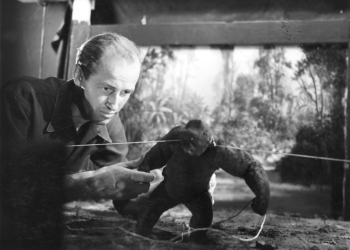
Harryhausen’s encounter with King Kong in 1933 opened a path from moviegoing to experimentation. Willis O’Brien’s work showed him that a constructed creature could become a compelling screen presence. Harryhausen later worked under O’Brien on Mighty Joe Young, developing performances in which strength and vulnerability could coexist. His early experiments and family-assisted fairy tales belong to this story alongside the better-known monsters. [1]
The craft behind the impossible
Harryhausen’s achievement joined animation to the practical demands of photography. The approach promoted as Dynamation combined miniature performance with photographed live action, using rear projection and carefully planned masking to make separate elements share a convincing space. Lighting, perspective and the actors’ movements all mattered. The illusion depended on preparation as much as on the animator’s patience. [2]
The documentary looks at those methods through individual films and creatures: the Ymir’s reactions, the coordinated combat of the skeletons, and Medusa’s watchful stillness. These sequences offer different answers to the same artistic problem: how does movement reveal character?
Sixteen features, many kinds of invention
The film covers every title in the principal feature-film body of work, including the dinosaur sequence for The Animal World, the spacecraft of Earth vs. the Flying Saucers, and the lunar adventure of First Men in the Moon. The range extends beyond a single creature type or compositing technique. [3]
- Mighty Joe Young (1949)
- The Beast from 20,000 Fathoms (1953)
- It Came from Beneath the Sea (1955)
- The Animal World (1956)
- Earth vs. the Flying Saucers (1956)
- 20 Million Miles to Earth (1957)
- The 7th Voyage of Sinbad (1958)
- The 3 Worlds of Gulliver (1960)
- Mysterious Island (1961)
- Jason and the Argonauts (1963)
- First Men in the Moon (1964)
- One Million Years B.C. (1966)
- The Valley of Gwangi (1969)
- The Golden Voyage of Sinbad (1973; U.S. release 1974)
- Sinbad and the Eye of the Tiger (1977)
- Clash of the Titans (1981)
The Golden Voyage of Sinbad carries a 1973 copyright; its 1974 U.S. opening accounts for the later year in some filmographies. [4]
An influence carried forward
The story also follows the collaborators who helped realize these films and the filmmakers who inherited their possibilities. George Lucas, Peter Jackson and Guillermo del Toro are part of that wider history of influence. Harryhausen’s legacy continues through the surviving models, drawings and production materials preserved by the Ray & Diana Harryhausen Foundation, established in 1986. [1], [3], [5]
Music by Mercury Waffle. Archival sources and image credits appear throughout the documentary.
Images from the workshop
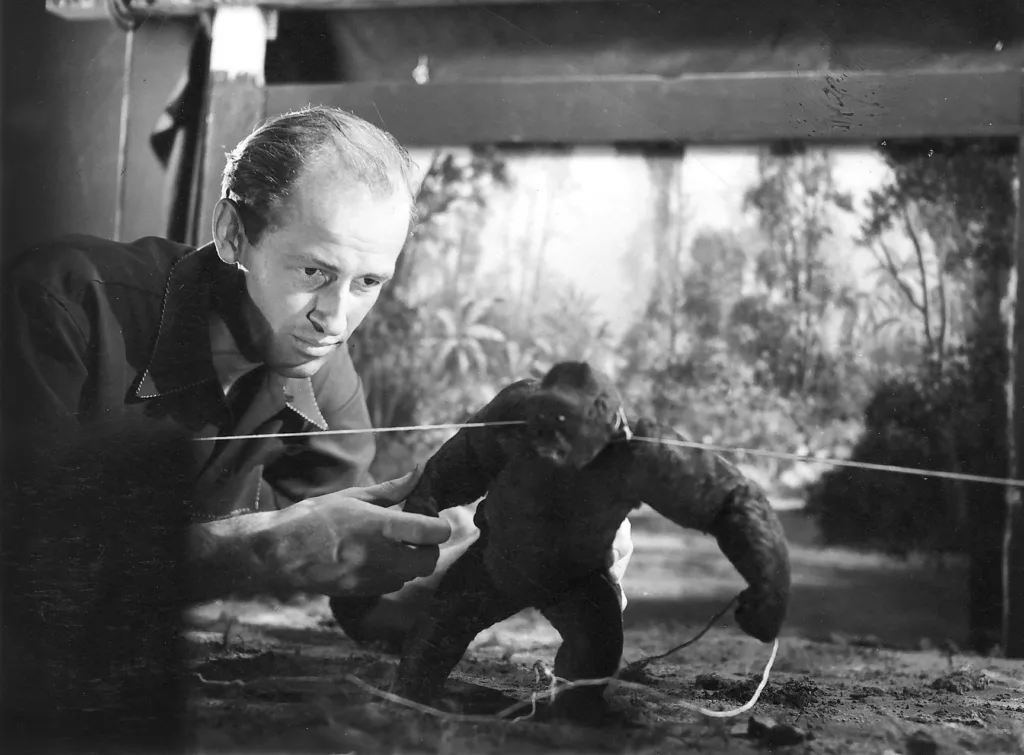
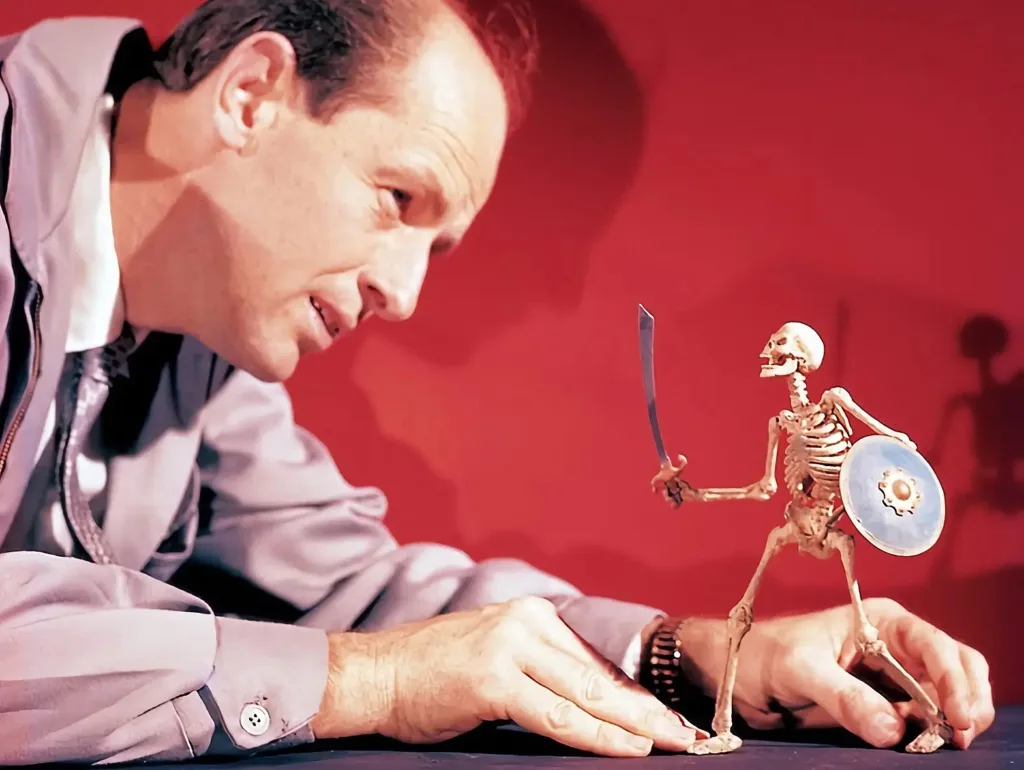
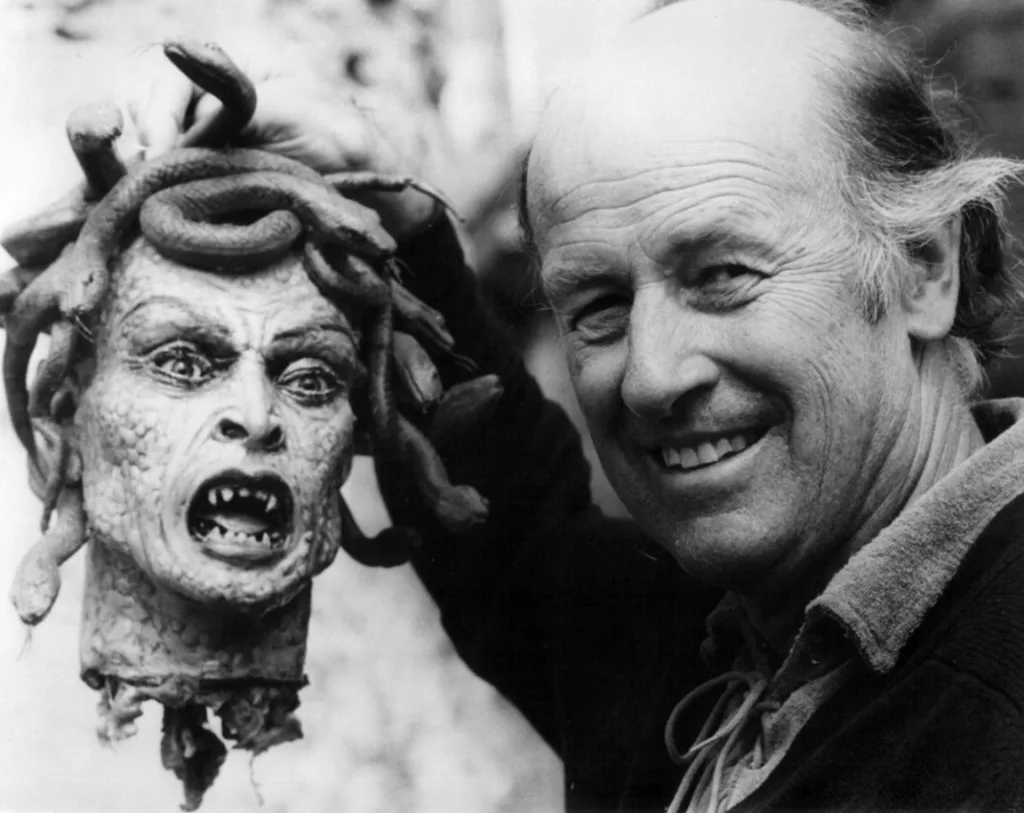
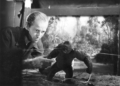
Harryhausen animating Mighty Joe Young; working with the skeletons of Jason and the Argonauts; and holding Medusa from Clash of the Titans. Archival production photographs via American Cinematographer. [2]
References
- National Galleries of Scotland — Ray Harryhausen: The grandfather of stop-frame animation.
- American Cinematographer — Ray Harryhausen Talks About His Cinematic Magic.
- BAFTA / BFI — Ray Harryhausen: A 90th Birthday Celebration, including George Lucas’s introduction and selected filmography.
- Sony Pictures — The Golden Voyage of Sinbad; AFI Catalog — release and production record.
- The Ray & Diana Harryhausen Foundation — About the Foundation.