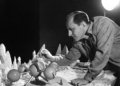
Watch Stop Motion Magazine’s Charley Bowers documentary above. Episode 009 explores a filmmaker whose inventions could hatch, vanish or develop personalities of their own. The complete film runs approximately three minutes and twenty-three seconds. Watch on YouTube.
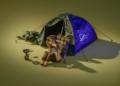
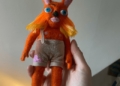
A machine’s gloved hand reaches across a workbench. An unfinished doll sits up, folds down and begins to seem less like a collection of parts than a small performer. This passage from A Wild Roomer opens our documentary because it brings Bowers’s appeal into focus: the pleasure of an impossible event, followed by the surprise of recognizing a character inside it.
A doll becomes a performer
A Wild Roomer places Bowers’s inventor in a boarding house disrupted by his experiments. The film combines live action with animated objects, turning domestic routines into occasions for mechanical mischief. Its credited filmmakers include Bowers and Harold L. Muller. [1]
The documentary pairs the doll’s performance with a simpler disappearance gag: a washbasin vanishes, followed by a jug that leaves its handle in a woman’s hand. Her reaction completes the joke. With the doll, the interest shifts toward movement itself. A pause, a change of balance and a small gesture give the object an apparent intention. Watching those details is a useful exercise for animators: character can emerge through timing before an audience knows anything about a puppet’s story.
From drawn cartoons to impossible inventions
Bowers’s work in animation began before these live-action comedies. Bud Fisher’s Mutt and Jeff cartoons were produced through the studio of Raoul Barré and Bowers. In the surviving On Strike (1920), the two cartoon characters attempt to make their own film, discovering the labor involved in getting drawings to move. The episode supplies a playful introduction to the production world behind Bowers’s later inventions. [2]
In Egged On (1926), the inventor’s pursuit of an unbreakable egg leads to an extraordinary image: tiny cars hatch and gather around a full-sized automobile. The transformation gives a manufactured object the behavior of a living creature. Bowers, Muller and Ted Sears are credited on the film, a reminder that these comedies also grew from collaboration. [3][1]
A detective small enough for a matchbox
There It Is (1928) gives Bowers a particularly memorable partner. As a Scotland Yard detective, he travels with MacGregor, a tiny bug who lives in a matchbox. Muller is credited as both director and cinematographer. [4]
Our documentary lets MacGregor’s movement play long enough to register as a performance. Bowers’s attention to his assistant helps sell the relationship: the human actor gives the miniature character room to act. Their exchange makes scale part of the comedy while keeping the bug’s personality at its center.
New settings for animated objects
The film also visits It’s a Bird, with its metal-eating creature, and Bowers’s later work on Pete-Roleum and His Cousins (1939). Made for the New York World’s Fair, the latter turned oil drops into puppet characters for a petroleum-industry promotion. Joseph Losey directed and produced it; the preservation record credits Bowers with animation and Lou Bunin with puppetry. These distinct contributions matter when tracing how the film’s characters reached the screen. [5]
Finding Bricolo again
The documentary closes with the rediscovery of films whose French prints identified their star as Bricolo. Three comedies brought by the Cinémathèque de Toulouse screened at Annecy in 1976. Comparing surviving copies, making new negatives in Belgium and continuing research in Montréal helped reconnect the films with Bowers’s name and career. The Cinémathèque québécoise’s 1980 dossier records this collaborative recovery. [3]
Return to the opening doll after watching the film. Its changing balance and brief hesitations remain easy to read across a century. That small performance offers a practical reason to revisit Bowers: the machinery creates the spectacle, but the animation gives us someone to watch.
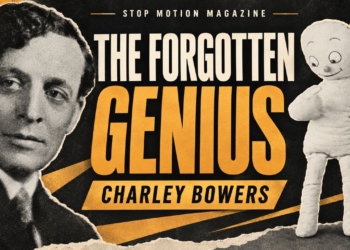
Documentary: Stop Motion Magazine, episode 009. Archival film sources and credits appear in the video. Featured artwork: Stop Motion Magazine editorial collage using a Bowers portrait from Photoplay, February 1928, and a frame from A Wild Roomer.
Continue the series with Aleksandr Ptushko: From Puppet Performance to Soviet Screen Fantasy.
References
- Cinémathèque québécoise — Early Fantasies: A Wild Roomer and Egged On programme credits.
- National Film Preservation Foundation — Mutt and Jeff: On Strike (1920), film and preservation notes.
- Cinémathèque québécoise — No. 8, Charles R. Bowers (July 1980).
- AFI Catalog — There It Is (1928): credits and synopsis.
- National Film Preservation Foundation — Pete-Roleum and His Cousins (1939): production credits and film description.