Marek Skrobecki’s D.I.M. — A Haunting Portrait of Routine in Puppet Animation
Few stop-motion filmmakers have explored the emotional depth of puppet animation as poetically as Polish director Marek Skrobecki. His 1992 short film **D.I.M.—produced at the legendary Se-ma-for Studios—remains one of the most distinctive works to emerge from Eastern European animation in the early 1990s. Known for its expressive atmosphere, human-scale puppets, and nearly silent storytelling, the film continues to fascinate animators and cinephiles more than three decades after its release.
Released in 1992, D.I.M. was directed and co-written by Skrobecki, with additional writing by Maciej Bełdycki. The film uses puppet animation to examine the repetitive, ritual-based life of an elderly couple living in a small apartment. With no spoken dialogue, the narrative relies entirely on visual cues, body language, and rhythmic movement to convey emotion. Much like Skrobecki’s later works, the short favors a deep, existential mood over literal explanation—inviting audiences to interpret the film’s metaphors for themselves.
Set within a meticulously crafted interior space, the story follows the couple’s simple routine: preparing food, reading, and most significantly, feeding a small bird that visits their window each day. The bird becomes a symbolic lifeline—an embodiment of hope, companionship, and meaning. When the bird stops appearing, their world loses its fragile balance, casting the couple into a quiet despair. With its understated tone and symbolic imagery, D.I.M. resonates as a reflection on aging, loneliness, and the delicate rituals that hold our lives together.
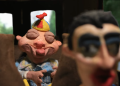
One of the most striking aspects of the short is its use of oversized, human-scale puppets, a technique that sets Skrobecki apart from many of his contemporaries. This approach gives the characters a sculptural presence and an uncanny realism, enhancing the melancholic mood and grounding the film’s surreal undertones. The tactile textures, carefully observed gestures, and shadow-rich lighting all contribute to what many viewers describe as a haunting, dreamlike atmosphere.
Skrobecki, trained at the National Film School in Łódź and later at Jim Henson’s Creature Shop and Aardman Animations, brought a rare level of craftsmanship to his early works. His partnership with Se-ma-for—already known for producing classics like The Adventures of Colargol and later Peter and the Wolf—gave D.I.M. both technical sophistication and a distinctive artistic voice. The film went on to win multiple awards at festivals in Europe, helping solidify Skrobecki’s reputation as one of Poland’s most important stop-motion auteurs.
Viewed today, D.I.M. stands as more than just an early work by a master animator. Its themes feel timeless, and its absence of dialogue gives the short a universal emotional clarity. It’s a film that encourages quiet reflection—reminding us of how fragile, and how precious, our daily patterns can be.
D.I.M. remains available to watch on YouTube, where new generations of animators continue to discover it and draw inspiration from its handcrafted artistry:
Watch the film:
https://youtu.be/Cjd16aDUk8s
Sources
-
Marek Skrobecki biography — https://en.wikipedia.org/wiki/Marek_Skrobecki
-
D.I.M. film listing — https://letterboxd.com/film/dim/
-
Culture.pl — Background on Marek Skrobecki — https://culture.pl/en/artist/marek-skrobecki
-
Film info and credits — https://www.shortfilmwire.com/en/embedded/film/100003097/Dim_