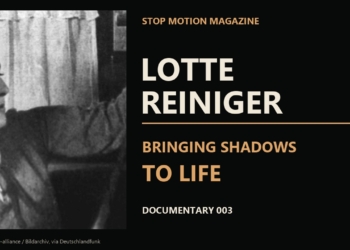
A head tilts, a hand rises, and a flat silhouette becomes a performer. Our new Lotte Reiniger documentary, The Woman Who Brought Shadows to Life, looks at the patient craft behind some of animation’s most expressive shadows.
Episode 003 of Stop Motion Magazine’s historical documentary series follows Reiniger’s work through archival photographs, film excerpts, and demonstrations of her technique. In three minutes and sixteen seconds, it connects the physical construction of her figures with the performances they create on screen.
Reiniger built articulated characters from separate pieces of card and thin lead, joined with wire. On a glass surface lit from below, small adjustments between exposures turned those pieces into movement. Her own 1936 account describes a practice rooted in silhouette cutting, theatre, and an exacting attention to gesture. [1]
The film revisits The Adventures of Prince Achmed (1926), the oldest surviving animated feature, and Papageno (1935), her playful interpretation of characters from Mozart’s The Magic Flute. Together, they show the range of an artist who could make a delicate outline feel adventurous, comic, or tender. [2] [3]
Watch the documentary above or on the Stop Motion Magazine YouTube channel. Look closely at a bent knee, a lifted hand, or a pause: the performance lives in the change between frames.
Featured image: Lotte Reiniger portrait crop, picture-alliance / Bildarchiv, via Deutschlandfunk. Documentary: Stop Motion Magazine. Archival credits appear in the film.
References
- Lotte Reiniger, Sight and Sound / BFI — Scissors make films (1936; republished 2020).
- BFI — The Adventures of Prince Achmed.
- LotteReiniger.de — Papageno (1935).