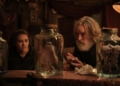
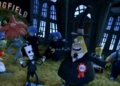
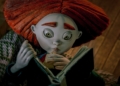
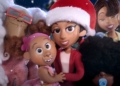
An insect peers through a camera. A dog reaches toward a child. A king listens from his throne. In Ladislas Starevich’s films, small physical actions carry recognizable intentions. Our short documentary follows that ability to make a constructed figure appear to notice, want and react.
The film brings together excerpts from The Cameraman’s Revenge, The Mascot and The Tale of the Fox, alongside family photographs and details of surviving puppets. Its subject is the craft of performance: how the materials inside a figure become part of a character’s life on screen.
From insects to actors
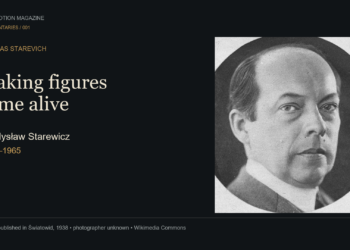
Born Władysław Starewicz in Moscow in 1882 and raised in Kaunas, the filmmaker developed interests in drawing, photography and insects before his career took him through Russia and into France. He left Russia in 1919 and settled in France in 1920. [1]
An account of his early experiments describes beetles that stopped moving under the strong light needed for filming. Starevich prepared specimens and arranged their movements himself. It is a striking origin story, but the lasting achievement lies in what he did with those movements. [2]
In The Cameraman’s Revenge (1912), insects inhabit a world of affairs, jealousy and exposure, with a cameraman turning private behavior into a public spectacle. [3] The miniature rooms and the characters’ entrances give their encounters a readable social rhythm. A pause or a turn makes the scene feel like an exchange between performers.
A family workshop
The French workshop depended on several members of the family. Anna Starevich made costumes. Their younger daughter Janina appeared on screen as Nina Star, while their elder daughter Irène became a filmmaking collaborator. [1] Irène shares directing, screenplay and animation credits with Ladislas on The Tale of the Fox. [4]
The documentary’s construction photographs show original puppets and components preserved by the Starevich family, including an articulated wooden hand and a figure with exposed wire. These are historical objects, rather than newly made demonstrations. The prepared beetles shown elsewhere are explicitly identified as a later reconstruction of an early experiment. [5]
In a 1946 description reproduced in Thomas Beaufils’s conservation study, Starevich outlined lightweight wooden supports, hinges, wire fingers, cotton padding and chamois coverings. Small pins secured feet to the set. [6] That account helps explain the practical relationship between holding a pose and changing it. It does not establish that every puppet in every film used an identical mechanism.
A dog, an orange and an animal court
The Mascot (Fétiche mascotte, 1933) gives its little dog a clear objective: obtaining an orange for a sick child. [7] That simple desire gives the fantastic encounters an emotional center. The dog’s reactions invite us to read the figure as someone with a purpose.
The Tale of the Fox expands puppet performance into a feature-length animal society. The animation was produced over eighteen months in 1929-1930; commercial releases followed in Germany in 1937 and France in 1941. [4] Those dates distinguish the making of the images from the film’s arrival in cinemas.
Watch the royal figures and the fox’s gestures in the documentary’s excerpts. The interest is not simply that an object moves. It is that the movement suggests a thought, an attitude or a response to another character. That remains one of the most useful things an animator can study in Starevich’s work.
Documentary: Stop Motion Magazine. Music: Original piece by Mercury Waffle. Archival film and image credits are included on screen and in the end credits.
Inside the family workshop
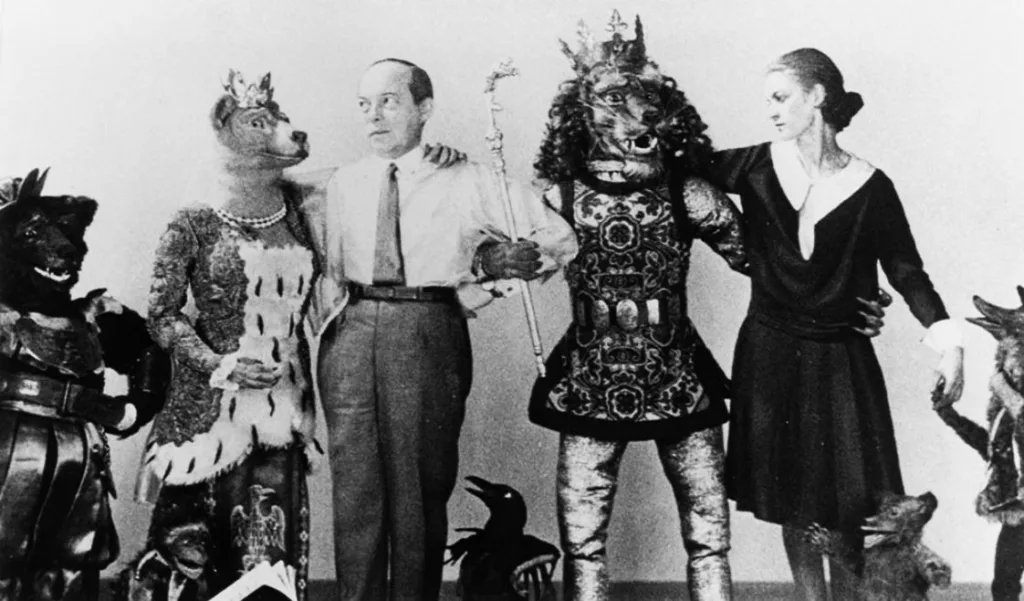
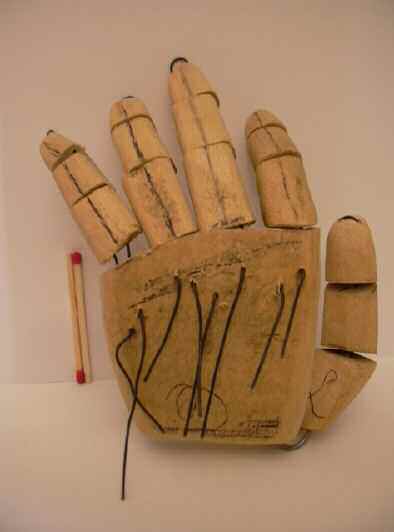
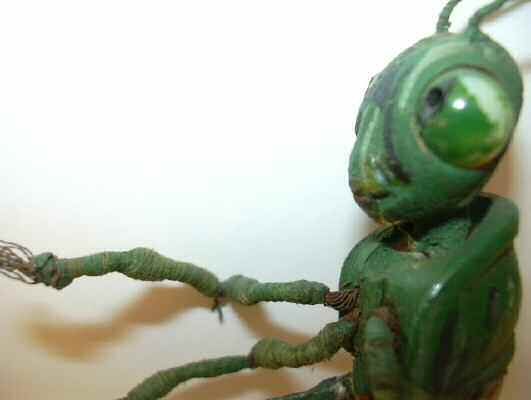
Slideshow: Ladislas and Irène with The Tale of the Fox puppets, circa 1930 (Se-ma-for Łódź, via Culture.pl and Manchester Museum); an original articulated wooden hand; and the original La Cigale puppet with exposed wire, both preserved by the Starevich family (family Fables dossier, p. 8). Family photograph source; puppet photographs source.
References
- Polish Biographical Dictionary, Roman Włodek — Władysław Starewicz.
- FINA, Michał Pieńkowski — Władysław Starewicz niezwykły.
- ACMI — Revenge of a kinematograph cameraman.
- AFCA — Le Roman de Renard.
- Starewitch family — Illustrated Fables educational dossier, pages 8, 10 and 11.
- Déméter, Thomas Beaufils — La conservation de marionnettes de télévision emblématiques du XXe siècle, including the attributed 1946 construction account.
- Festival La Rochelle Cinéma — Fétiche mascotte.