Watch the complete Stop Motion Magazine documentary above. Music by Mercury Waffle. Watch on YouTube.
A wooden figure takes a step. A toy begins to sing. A room becomes the starting point for a journey through time. Our new George Pal documentary follows the connection between these intimate acts of animation and the expansive worlds of his feature films. Archival photographs, film excerpts, surviving puppets, and animated maps trace a career built around making the imagined visible.
A life across Europe
Pal’s route to Hollywood passed through several European filmmaking centres. After beginning his career in Budapest, he worked in Berlin, then spent periods in Prague and Paris before establishing a studio in Eindhoven in 1934. Advertising commissions, including work for Philips, gave him opportunities to develop puppet performance alongside experiments with colour and recorded sound. Commercial filmmaking became a workshop for ideas that could travel far beyond the product being sold. [1]
The documentary also makes room for the life shared by George and his wife, Zsoka. She recalled meeting him at a dancing school, and the couple married in Budapest in 1930. Their story gives the changes of city and studio a human scale: a working partnership and a marriage unfolding alongside an increasingly ambitious filmmaking career. [2]
Building a performance, one shape at a time
Pal’s replacement animation approached movement as a sequence of designed shapes. A walk could require successive carved legs; changes of expression and bodily form could be prepared before photography began. Substituting these parts between exposures allowed solid figures to stretch and squash with the freedom associated with drawn animation. The apparent ease of the performance rested on careful planning, fabrication, painting, and registration beneath the camera. [3]
His Hollywood workshop also provided an early professional home for Ray Harryhausen, who began working on the Puppetoons before developing the creature performances for which he became celebrated. [4] Pal’s own contribution received special recognition in 1944, when the Academy presented him with an honorary Oscar for the methods and techniques behind his Puppetoons. [5]
From miniature performers to imagined worlds
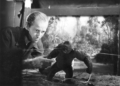
The film follows Pal beyond the shorts into a wider range of productions. In The Great Rupert (1950), produced by Pal and directed by Irving Pichel, a squirrel shares the screen with live actors; its performance combines a real animal with a stop-motion puppet. [6] That same year, their Destination Moon brought together an imagined lunar voyage, scientific consultation, Robert Heinlein’s writing and technical advice, and Chesley Bonestell’s astronomical art. [7]
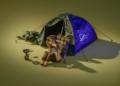
The documentary’s excerpts also range across When Worlds Collide, The War of the Worlds, Houdini, and The Naked Jungle, before returning to the miniature pleasures of Tom Thumb. One surviving object makes the craft especially tangible: the Yawning Man puppet and its twenty-seven interchangeable faces. A whole performance can be considered through these small, successive changes. [8]
For The Time Machine (1960), Pal served as both producer and director. Flowers bloom and fade, shop-window fashions change, and years pass around a seated traveller. Special photographic effects credited to Gene Warren and Wah Chang help turn the passage of time into something an audience can see. [9]
Seen together, these images retain the pleasure of discovering how a thing moves. The carved figure, the changing face, and the miniature landscape remain close enough to imagine someone’s hands at work. Then the film begins, and those small creations open onto somewhere much larger.
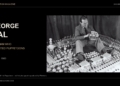
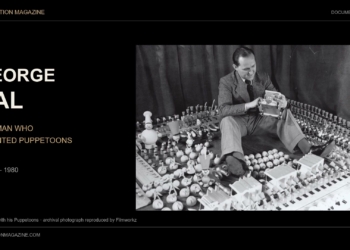
Documentary research, writing, maps, and edit: Stop Motion Magazine. Music by Mercury Waffle. Archival and collaborator credits appear in the film. Featured image: documentary title frame with an archival photograph of George Pal and his Puppetoons, reproduced by Filmworkz.
References
- Mette Peters — George Pal’s Cavalcade of Colours, Music and Dolls, especially pp. 56–57 and 63–64.
- Justin Humphreys — George Pal: Man of Tomorrow, BearManor Media, 2023; authorized book preview.
- Mark Mayerson, Library of Congress — Tulips Shall Grow, National Film Registry essay.
- National Galleries of Scotland / Nick Setchfield — Fame in the Frame: SFX Magazine on Ray Harryhausen.
- UCLA Film & Television Archive — Restored Classic Animation.
- American Film Institute — The Great Rupert, AFI Catalog.
- American Film Institute — Destination Moon, AFI Catalog.
- Smithsonian National Museum of American History — Yawning Man with 27 Faces, gift of Elisabeth Pal.
- American Film Institute — The Time Machine, AFI Catalog.