Watch our Hermína Týrlová documentary above, or watch it on YouTube with selectable English captions.
A knot in a handkerchief can suggest a head. A loose strand of wool can become a body. In Hermína Týrlová’s films, everyday materials retain their familiar textures while acquiring intentions, moods and comic timing. This documentary follows the Czech filmmaker’s life and the practical imagination behind her toys, cloth characters and wool films.
From Prague to the Zlín studios
Born in Březové Hory near Příbram in 1900, Týrlová worked in theatre in Prague before developing her animation skills alongside Karel Dodal. Their advertising work provided experience in drawing and the frame-by-frame construction of movement. In 1941 she accepted an opportunity at the Zlín studios, where she could pursue a puppet film based on Ondřej Sekora’s Ferda the Ant.[1]
Ferda mravenec, made in 1942, is credited to directors Týrlová and Ladislav Zástěra. Its small-scale adventure turns an ant and his companions into performers, with movement carrying the action as they outwit a spider.[2] For an animator, the appeal lies in the relationship between a recognizable character and a physical object: posture and the spacing of each movement must make that tiny figure readable.
Toys share the frame with people
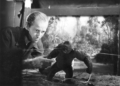
Týrlová also explored encounters between animated objects and live actors. The Revolt of the Toys (1947), co-directed with František Sádek, places a group of toys against a Nazi soldier in a toy workshop. Their collective resistance turns the difference in scale into an advantage.[3] Watching the sequence, the comedy depends on the toys’ coordinated actions and the human performer’s responses: the two kinds of performance must appear to occupy the same world.
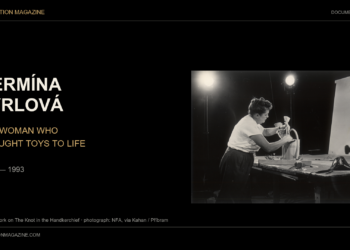
The Knot in the Handkerchief takes an even more ordinary object as its starting point. Produced in 1958 and released in 1959, the film combines object animation with live action and credits Týrlová and Josef Pinkava as directors, with cinematography by Antonín Horák. It received awards at Locarno and Mar del Plata in 1959.[4] The handkerchief’s folds and changes of posture give the viewer something to read as expression, without concealing what the object is made from.
Letting the material shape the movement
In A Woollen Tale (Vlněná pohádka, 1964), the material itself becomes a production problem and a creative resource. Týrlová described an early experiment with wool reinforced by lead wire that produced movement she found too stiff. The film credits animation to Jan Dudešek and Garik Seko.[5] That experiment offers a useful lesson: a support that holds a pose can also suppress the quality that made the material interesting.
The excerpts in the documentary invite close attention to these choices. Watch how a fold changes a silhouette, how a pause establishes a reaction, and how the softness of wool affects the character’s apparent weight. Across these different objects, performance grows from the animator’s handling of the material.
Documentary: Stop Motion Magazine
Music by Mercury Waffle
Archival sources and image credits appear throughout the film. Location-photograph attributions and licence links are included in the YouTube description.
References
- Masaryk University, Zlinet. Hermína Týrlová — biographical entry.
- Národní filmový archiv. Ferda mravenec — film record.
- Michaela Mertová, Filmový přehled / Národní filmový archiv, 11 December 2015. Hermína Týrlová.
- Masaryk University, Zlinet. Uzel na kapesníku — production, credits and awards.
- Masaryk University, Zlinet. Vlněná pohádka — credits and contemporary production account.