Humantis: A Meditation on Change, Identity & Craft in Paris Baillie’s Stop-Motion Short
Paris Baillie’s stop-motion short Humantis has resonated across the global festival circuit, captivating audiences with its intimate blend of handcrafted artistry and emotional depth. The nine-minute film centers on a species of mantis-plant hybrid creatures, the Humantises, who move in coordinated harmony and blend seamlessly into their environment. Their world is one of controlled symmetry and shared identity—until one Humantis begins to change. As its once-white body shifts into shades of green, the creature hides the transformation with growing desperation, fearing the consequences of standing out. What unfolds is a visually rich and deeply empathetic meditation on identity, denial, and the difficult beauty of change.
The origins of Humantis can be traced to a period of profound transition in Baillie’s life. While researching orchid mantises and their evolutionary camouflage, she discovered that their behavior echoed her own experience of resisting personal growth. “I became obsessed with orchid mantises and their form of camouflage called aggressive mimicry,” she explained. “I was inspired by the idea of camouflage and trying to hide from change, because I had some big life changes that felt hard to navigate at the time I started to develop this film” . A friend’s comment that she was “a plant trying to rush and control my growth – which is impossible to do” became an early touchstone for the film’s emotional center . In shaping its story, Baillie found that the parallels between mantis biology and human experience formed a natural foundation for a narrative about adaptation and self-acceptance.

As audiences have watched Humantis, interpretations have ranged widely—touching on themes of body image, mental health, environmental change, conformity, and self-realization. Baillie welcomes these perspectives. “Change is a universal and inescapable experience that can be for the worse, or for the better. Yet, we can adapt, learn to accept, and grow,” she said. She added that the film no longer feels personal to her alone: “Hearing people’s different interpretations and how they relate to the main Humantis in the film has been very meaningful” . Critics have echoed this universality, noting that the shifting colors of the protagonist can be read as a metaphor for everything from identity formation to the painful rupture between who we were and who we are becoming.
The visual world of Humantis emerges from Baillie’s fascination with creatures that are both alluring and unsettling. “Praying mantises are both beautiful and terrifying, which is very much my style,” she said, describing how she designed each puppet by blending human gestures with mantis structure . The flower Humantises share similar petal-based features, while the leaf Humantises vary widely in color and shape, creating a visual contrast rooted in natural diversity. The film’s richly textured sets and puppets were constructed by hand, a process Baillie has described in interviews as ranging from delicate tissue-based layering to sculptural papier-mâché forms. Critics have praised the environment’s tactile quality, highlighting how the handcrafted surfaces reinforce the film’s emotional intimacy.
Music and sound further anchor the film’s expressiveness, especially in the absence of dialogue. Baillie not only composed the score but created the sound design, weaving experimental synth textures with field recordings captured near her home. “The music for the film needed to feel as other-worldly as the Humantis characters,” she said, noting that she experimented with synthesizers for the first time to achieve the desired tone . Some of the film’s most memorable sounds emerged unexpectedly: for example, the recurring high-pitched note that floats through the short is, in reality, “a hummingbird flying by” her recorder during production . This blend of natural sound and constructed atmosphere contributes to a world that feels familiar but distinctly alien.

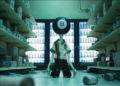
Animating Humantis demanded both creative playfulness and technical endurance. Baillie said she especially enjoyed “the flower Humantis dance sequences, and their beauty routines,” which were influenced by everything from Busby Berkeley musicals to the “Beautiful Girls” sequence from Singin’ in the Rain, and even the visual impact of Rihanna’s Super Bowl halftime performance . These sequences gave Baillie room to explore choreography, rhythm, and group movement in ways that push stop-motion into theatrical territory. Other scenes, however, tested her patience and persistence. The film’s final shot—featuring the transformed Humantis climbing upward through a densely lit set—was, she admitted, “painfully the hardest scene to animate.” Lighting the scene with a disco ball proved disastrous: “I don’t know why I thought it would be fine to light that set with a giant disco ball,” she said with humor, recalling how she had to reanimate the moving camera shot multiple times as the reflections shifted unpredictably . The challenge ultimately added to the film’s layered visual complexity, though Baillie has joked that she learned several invaluable lighting lessons along the way.
Humantis debuted at the Annecy International Animation Film Festival before continuing on a significant festival run. In 2024, the film won the Grand Jury Prize for Animated Short at AFI FEST—an Oscar-qualifying honor. The AFI jury called the film “a stunning work of art that delves into the complexities and challenges of change and the unexpected beauty that emerges from self-transformation and acceptance,” noting that its stop-motion “breathes new life into an otherworldly visual narrative, showcasing the depths of a vibrant imagination and skillful craftsmanship” . The film later won Best Animated Short at the Brooklyn Film Festival and has screened at more than twenty festivals worldwide, earning a slate of additional awards. Several reviewers have emphasized Baillie’s remarkable creative range—serving as director, writer, animator, composer, editor, designer, and cinematographer—an approach that gives Humantis a distinctly auteur-driven coherence.
Beyond its technical accomplishments, the film offers a gentle emotional resonance that has remained with viewers long after screenings. Baillie reflected on her own journey while making the film, saying, “After making this film, I personally feel less afraid of change. I have grown a lot since then, and it feels good.” She expressed hope that “anyone who watches Humantis feels less alone in processing a change or conflict they may be going through. Life is beautifully complicated” . Through its careful puppetry, universal imagery, and striking visual poetry, Humantis stands as a poignant reminder of the vulnerability—and the quiet courage—embedded in the process of becoming someone new.


Sources
Primary Sources Provided by User (Quoted in Article)
Film Fugitives – Interview with Paris Baillie
https://fugitives.com/interview-humantis-film-director-paris-baillie-2025/
Cinemacy – Humantis Review
https://cinemacy.com/humantis-review/
Animation Magazine – AFI FEST Award Announcement
https://www.animationmagazine.net/2024/10/humantis-wins-oscar-qualifying-animation-prize-at-afi-fest/
Cartoon Contender – Interview with Paris Baillie
https://cartooncontender.com/news-and-reviews/2026-oscar-eligible-animated-short-humantis-interview-paris-baillie
Battle Royale With Cheese (BRWC) – Review of Humantis
https://battleroyalewithcheese.com/2025/04/humantis-review
Film Threat – Review of Humantis
https://filmthreat.com/reviews/humantis
GHMovieFreak – Review of Humantis
https://ghmoviefreak.com/short-film-review-humantis-what-happens-when-you-dont-conform
Brooklyn Film Festival – Humantis Listing
https://www.brooklynfilmfestival.org/film-detail?fid=2850
Official Film Website – Humantis
https://www.parisbaillie.com/humantis